 Kyoto City Guide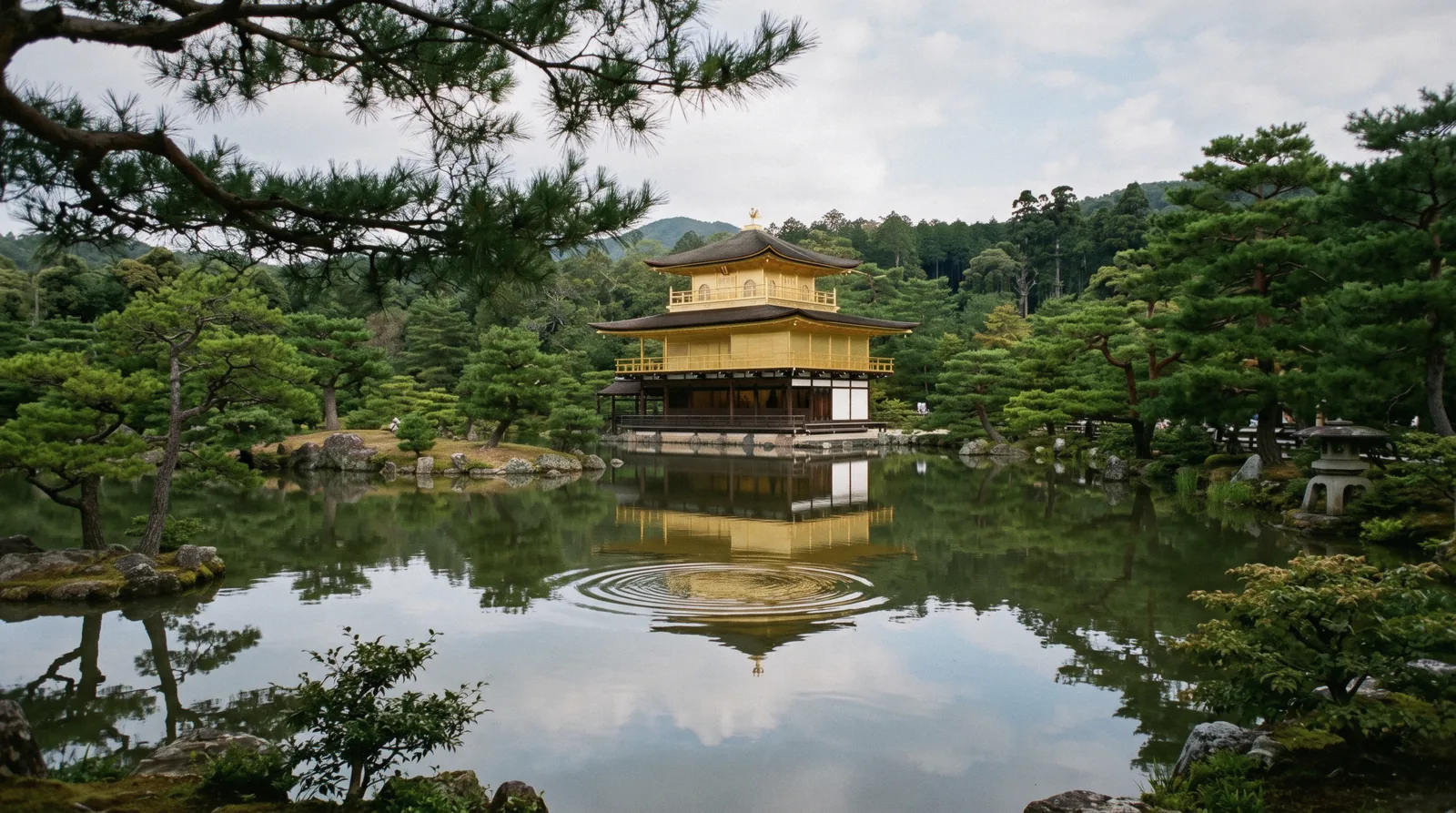
Kinkaku-ji, the Golden Pavilion
Kinkaku-ji — formally Rokuon-ji, and universally the Golden Pavilion — is a three-storey reliquary hall covered in gold leaf, standing at the edge of a pond in the north-west of the city. It costs $3.13 (¥500), opens at 09:00 and takes most people about twenty-five minutes, because the visit is a one-way circuit and you never go inside. This page has the hours, the fee read off the temple's own site, the buses and what to do with the rest of the morning. The city plan is on the page covering what to do in Kyoto.
Quick answer $3.13 (¥500), 09:00–17:00, 25 minutes — in four lines
Kinkaku-ji charges $3.13 (¥500) for adults and $1.88 (¥300) for elementary and junior-high pupils, opens 09:00 and closes 17:00, and is open every day of the year. Figures from the temple's own site. The visit is a fixed one-way path around a pond and takes about twenty-five minutes.
Key takeaways
- You do not go inside the pavilion, ever — the gold is seen across water from a path, which is why the visit is short and why pairing it with Ryoan-ji makes a better morning than stretching it out
- At $3.13 (¥500) it costs half of what Ginkaku-ji charges, and the two are on the same bus line 204
- Four city bus routes stop at Kinkakuji-michi — 12, 59, 205 and M1 — and a $6.88 (¥1,100) day pass pays for itself on any day that includes this trip
- A guided visit with the ticket included explains the burning of 1950 and the rebuilding, which the temple's own signage does not
Key facts
Opening hours
| Daily, all year | 09:00–17:00 |
|---|---|
| Car park | 08:40–17:10 |
Closed None — the temple states it is open year-round
Admission
- Adult
- $3.13 (¥500)
- Reduced
- $1.88 (¥300) elementary and junior-high school
- Free
- Not stated by the temple
Planning it
- Time needed
- Not stated by the temple; our routing: 25 to 35 minutes for the full circuit
- Book ahead
- Optional — walk-up usually fine
- Address
- 1 Kinkakuji-cho, Kita-ku, Kyoto 603-8361 (temple office 075-461-0013)
The temple sells one ticket at one window, and nobody can sell you a faster way in. Prices from shokoku-ji.jp and converted at ¥160 = $1; the tour prices are GetYourGuide's listings.
The gate is $3.13 (¥500), sells at the window and takes no bookings — so the real question is whether twenty-five minutes is enough, and what you attach to it.
| Option | Price | What it covers | Cancel | Book |
|---|---|---|---|---|
| Temple window, on the dayEveryone; nobody can sell you a faster way in, because there is no queue to skip | $3.13 (¥500) adult / $1.88 (¥300) child | The full one-way circuit and the garden; no interiors are open | Not applicable | Official site |
| Guided visit with admission includedAnyone who wants the 1950 fire and the rebuilding explained, which the site does not | From $62.47 | Guide, the $3.13 (¥500) entry, 1.5 to 3.5 hours depending on option | Free up to 24 hours before | Check Availability |
| Two-temple tour with monk-guided optionThe monk option only — it opens halls a walk-up visitor never sees | From $57.47 | Tickets, and on the monk option the Golden Hall and Sutra Hall, normally closed | Free up to 24 hours before | Check Availability |
| Half-day bus: Kinkaku-ji, Ginkaku-ji, Kiyomizu-deraThree temples in a half day, though the coach includes no admission | From $43.10 | Coach, audio guide in three languages, free time at each | Free up to 24 hours before | Check Availability |
There is no skip-the-line product here and no queue worth skipping: the window takes a few minutes even at eleven o'clock. What clogs is the path at the pond, and no ticket changes that. The monk-guided option on the two-temple tour is the one genuinely unavailable to a walk-up visitor.
Ways to visit Kinkaku-ji, compared
Prices are the platform's listings in USD; the operator charges in your own currency at checkout.
 from $62.47
Kyoto: Kinkakuji, Golden Pavilion Guided Tour
A guided circuit of the Golden Pavilion with the ¥500 admission included and the history that the site's own signage leaves out. Ninety minutes to three and a half hours, depending on the option.
Check Availability from $57.47
Kyoto: Kinkaku-ji Temple & Serene Garden Tour with Tickets
Two UNESCO temples with tickets, and on the monk-guided option, access to the Golden Hall and Sutra Hall plus a chanting session — rooms that are closed to ordinary visitors.
Check Availability from $43.10
Kyoto: Bus Tour to Kinkaku-ji, Ginkaku-ji & Kiyomizu-dera
Half a day and an audio guide rather than a live one: Kinkaku-ji, Ginkaku-ji and Kiyomizu-dera by bus with free time at each. The cheapest way to link the three temples that are furthest apart.
Check Availability from $63.75
Kyoto: Early Morning Tour of Fushimi Inari, Arashiyama and Kinkakuji
Starts before the crowds: Fushimi Inari, Arashiyama's bamboo and Kinkaku-ji in six hours with an English-speaking guide and lunch. The early slot is the whole point — these three are unrecognisable after 10:00.
Check Availability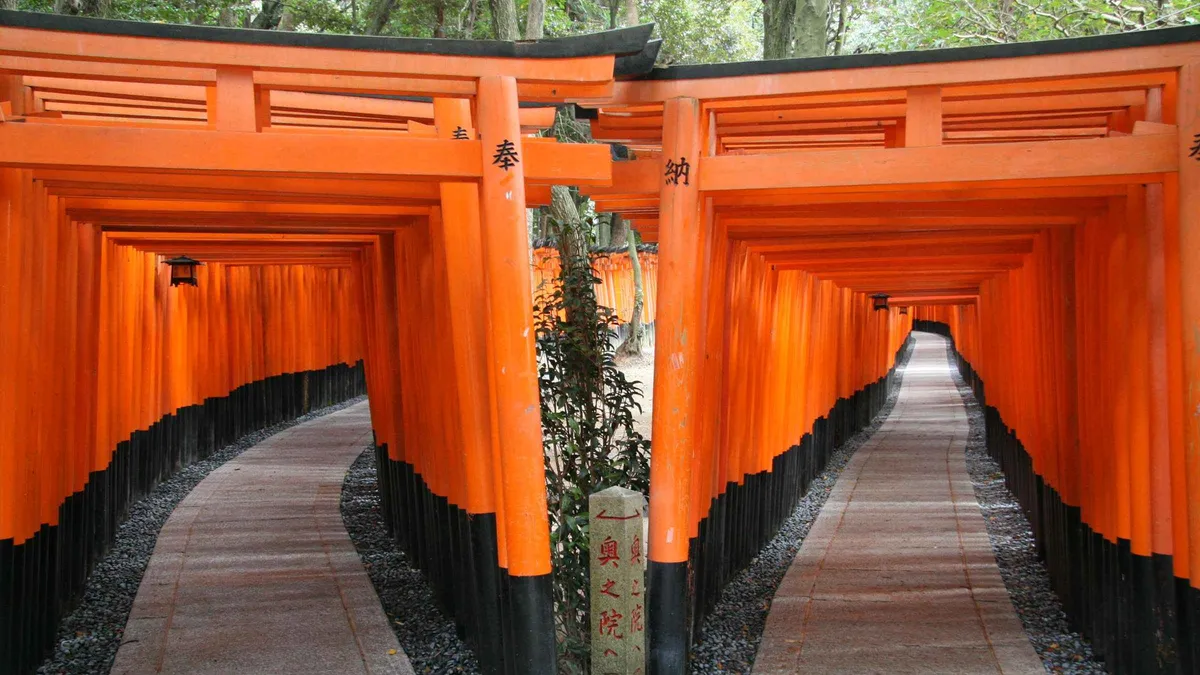 from $94.95
Kyoto: Fushimi Inari, Kinkakuji, Bamboo Grove 1-Day Bus Tour
The all-in coach day: Kiyomizu-dera, Sanjusangen-do, Tenryu-ji, the bamboo grove, Kinkaku-ji and Fushimi Inari with entry tickets and a Japanese buffet in one 8.5-hour run. The most reviewed Kyoto tour on the platform.
Check Availability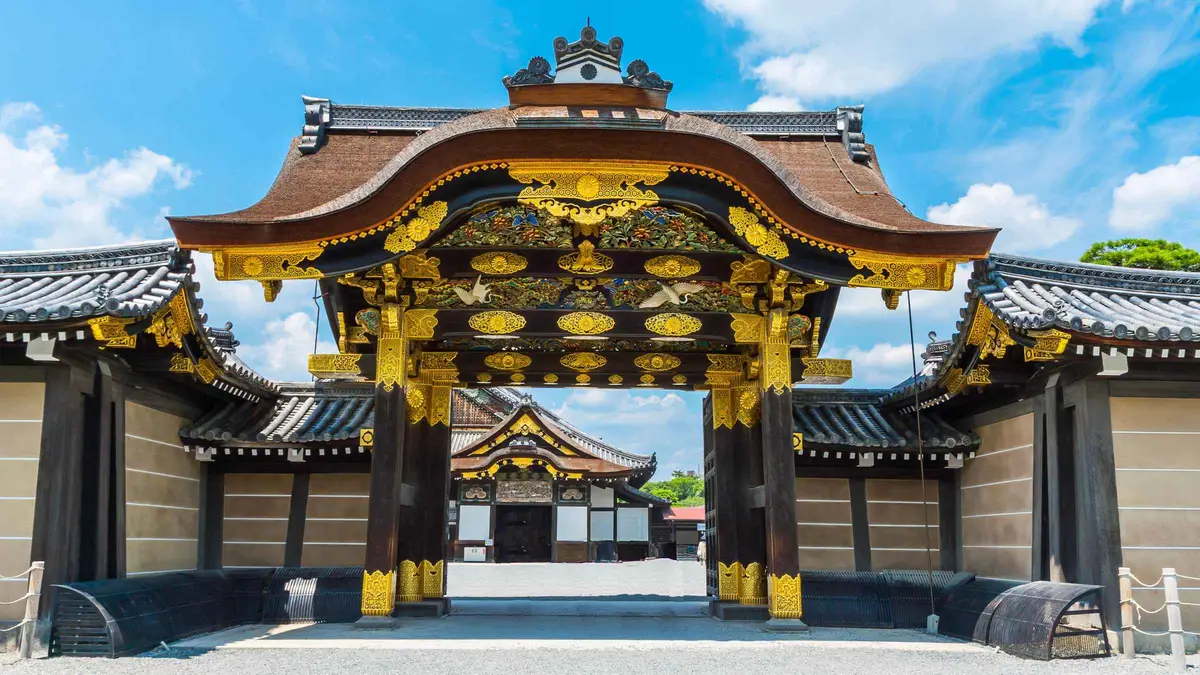 from $48.72
Kyoto/Osaka: Nijo Castle, Arashiyama, Kinkakuji Day Tour
Nijo Castle, Kinkaku-ji, Fushimi Inari and Arashiyama in one air-conditioned run, with an English and Chinese guide and round-trip transfers. Departs from Kyoto or Osaka, which is what makes it cheap.
Check AvailabilityPrices, ratings and details are the platform's own. Dollar figures are the listed prices. The platform bills in your account's currency.
What you actually see, and why it takes twenty-five minutes
The circuit is fixed, one-way and short. Knowing that in advance changes how you plan the morning rather than spoiling it.
You enter through the Sōmon gate, turn a corner, and the pavilion is in front of you across the Kyōko-chi, the mirror pond — which is the view, and it arrives in the first ninety seconds. The path then runs behind the pavilion, past the Ginga-sen spring and the Anmintaku pond, up a slope past the Sekkatei tea house and out through the shop. You cannot enter the pavilion, you cannot approach it beyond the fence, and you cannot walk the route backwards.
The three storeys are three architectures stacked: a Heian-style residential floor at the bottom, a samurai-style hall above it, and a Chinese Zen hall at the top, the upper two sheathed in gold leaf with a bronze phoenix on the roof. That is the payload of the visit, and once you have seen it from the two viewpoints on the pond there is not much more the site offers.
1950, and why the building is younger than the tourists
The pavilion standing today dates from 1955. In July 1950 a novice monk burned the original to the ground, an act Yukio Mishima turned into the novel The Temple of the Golden Pavilion. The reconstruction followed the original form, and the gold leaf was renewed in 1987 in a considerably thicker application than the medieval one — which is why photographs from before and after look like different buildings.
None of this is explained on site in English, and it is the main thing a guide adds.
The order to walk it in
Arrive at 09:00 and the pond is calm and the reflection is clean; by 10:30 the front viewpoint is three people deep. In winter the site sells the picture everyone wants — snow on the roof — and the temple stays open in it. The path is gravel and gentle, with one short slope, and takes wheelchairs and pushchairs without difficulty apart from that slope.
Kinkaku-ji in nine dates
The temple publishes most of this itself, and is silent on the one date every visitor asks about. Both halves are below.
-
1224
A dedication on this ground
The Saionji family holds an estate here and dedicates its temple, Saion-ji, two centuries before Yoshimitsu arrives. The poet Fujiwara Teika records a visit the following year, in 1225.
-
1394
Yoshimitsu retires
Ashikaga Yoshimitsu, the third Muromachi shogun, hands the office to his son and keeps the power, which is the usual arrangement of the period.
-
1397
The Kitayama palace is begun
Yoshimitsu buys the Saionji estate and builds a retirement palace on it. The Golden Pavilion is a building in that complex, not a temple; everything else on the site has since gone.
-
1408
The Imperial visit, and the end
The emperor is received at Kitayama in 1408, the year Yoshimitsu dies. Under his will the palace becomes a Zen temple, Rokuon-ji, which is still its formal name.
-
1467–1477
The Onin War spares it
The war that burns most of Kyoto to the ground reaches this valley and the pavilion survives it — which is why the building that stood here until 1950 was a genuine medieval one.
-
1894
Opened to the public
The temple begins admitting visitors, and has been a paying gate ever since. Today's fee is $3.13 (¥500).
-
2 July 1950
A novice burns it down
At 2:30 in the morning a 22-year-old novice monk, Hayashi Shoken, sets fire to the pavilion; it is destroyed. Yukio Mishima turned the case into The Temple of the Golden Pavilion six years later.
-
1955
Rebuilt to the original form
The reconstruction is completed five years after the fire. Everything you photograph is younger than most of the people photographing it.
-
1986–1987, then 1994
Re-leafed, then inscribed
The peeling gold is replaced with about twenty kilograms of new leaf, considerably thicker than the medieval application — which is why photographs from before and after look like different buildings. UNESCO inscribes the temple in 1994.
Sources: the temple's own history at shokoku-ji.jp for 1224, 1225, 1394, 1397, 1408, the Onin War, the 1894 opening and the 1994 inscription; the Wikipedia article on Kinkaku-ji for the date, hour and arsonist of the 1950 fire, the 1955 completion and the 20 kg of gold leaf applied in 1986–87. The temple's own pages do not mention the fire at all.
How much time to give Kinkaku-ji
The temple states no visit length, and the honest answer is shorter than anybody expects: the circuit is one-way, fixed and about twenty-five minutes. So the real question is what you attach to it. Door-to-door figures start and finish at Kyoto Station, 40 minutes away on city bus 205.
There is no version of this visit that fills a morning on its own, and pretending otherwise is how people end up with an hour to kill in the north-west of the city at half past ten. The three routings below are the ones that work.
| Routing | On site | Door to door from Kyoto Station | What you skip |
|---|---|---|---|
| Kinkaku-ji alone | 25–35 min | About 1 h 45 | Nothing here — but three quarters of your morning goes on the bus |
| Kinkaku-ji, then Ryoan-ji and Ninna-ji | 2 h 30 across the three | About 4 h, ending near 13:00 | Nothing; this is the page's own routing and the reason the Kinukake-no-michi exists |
| A guided visit with the ticket included | 1 h 30 to 3 h 30 by option | 2 to 4 h from the meeting point | Your own pace — and you gain the 1950 fire, which the temple explains nowhere on site |
Whichever you take, arrive at the 09:00 opening. The pond is calm, the reflection is clean and the front viewpoint is passable; by 10:30 it is three people deep, and because the path is one-way and narrow at the water the site clogs rather than queues. The last hour before the 17:00 close is the other clear window.
Getting to Kinkaku-ji
It is in the north-west, away from the subway, so this is a bus trip. The routes below are the temple's own list.
Everything stops at Kinkakuji-michi, a couple of minutes' walk from the gate. The routes below are the temple's own published list, with journey times from our own trips and the flat city-bus fare of $1.44 (¥230) applying to each of them.
| From | Route | Journey | Note |
|---|---|---|---|
| Kyoto Station | City bus 205 to Kinkakuji-michi | About 40 minutes | The direct one; slow in afternoon traffic |
| Downtown / Shijo | City bus 12 or M1 to Kinkakuji-michi | 25 to 35 minutes | M1 is the newer express-style service |
| Karasuma-Imadegawa or Doshisha-mae | City bus 59 | About 20 minutes | The temple's own suggested route from Shokoku-ji |
| Ginkaku-ji | City bus 204 from Ginkakuji-michi | About 35 minutes | The cross-city link between the two pavilions |
| By car | Temple car park, 250 spaces | 08:40–17:10 | Charged; the area is congested at weekends |
A single city bus ride is a flat $1.44 (¥230), so a return from Kyoto Station plus one more journey brings the $6.88 (¥1,100) Subway & Bus 1-day pass within reach — this is exactly the kind of day it was designed for. Note that the subway does not come here: the nearest station, Kitaoji, is a bus ride away in its own right.
What to pair it with, because twenty-five minutes is not a morning
The north-west has three sights within a short bus ride of each other, and they answer each other well.
Ryoan-ji is fifteen minutes away by bus and is the opposite experience: $3.75 (¥600) for fifteen rocks in raked gravel, which people either sit with for an hour or leave in five minutes. Ninna-ji, a further ten minutes on, is a vast temple complex with a five-storey pagoda and, in April, the late-blooming Omuro cherries. Together the three make a coherent half day that ends at about 13:00 — and the walk between Ryoan-ji and Ninna-ji, down the Kinukake-no-michi, is a pleasant twenty minutes rather than a bus ride.
The pairing to avoid is Kinkaku-ji with Arashiyama on the same morning: they look close on a map and the bus between them is slow enough to eat the time you saved.
- Kinkaku-ji 09:00, Ryoan-ji 10:00, Ninna-ji 11:15 — the classic north-west morning
- Kinkaku-ji plus the 204 bus east to Ginkaku-ji and the Philosopher's Path — a full day, and the two pavilions in one
- Kinkaku-ji as the first stop of a bus tour that carries on to Kiyomizu-dera, which is what most coach itineraries do
Dos and don'ts at Kinkaku-ji
The short version of everything above, for the morning you go.
Do
- Be at the gate for the 09:00 opening: the reflection is clean and the front viewpoint is walkable for about ninety minutes after that
- Pair it with Ryoan-ji and Ninna-ji — twenty-five minutes is not a morning, and the three make one
- Pay the $3.13 (¥500) at the window and walk in; there is no advance sale, no timed entry and nothing to book
- Buy the $6.88 (¥1,100) Subway & Bus day pass if this is on the day's list — at $1.44 (¥230) a ride it pays for itself here
- Come in winter if you can choose: snow on the gold roof is the picture, and the temple stays open in it
Don't
- Don't expect to go inside, or to get closer than the fence — you never do, and the view arrives ninety seconds after the gate
- Don't put this and Arashiyama in the same morning; they look close and the bus between them is slow enough to eat the time
- Don't buy a skip-the-line product: the window takes a few minutes even at eleven, and what clogs is the path, which no ticket changes
- Don't slot it into the middle of a day — the north-west has no subway, so a mid-afternoon visit costs two long bus rides through the centre
- Don't assume the building is medieval; it was finished in 1955, and the guide is the only thing on site that will tell you so
Kinkaku-ji map: the gate, the bus stop and the north-west chain
The temple, the stop the buses use and the two sights that make the rest of the morning.
Five things most visitors do not know about Kinkaku-ji
Facts that change how the pavilion reads, each with where it comes from.
- The temple's own website does not mention the fire. Its history page runs from the Saionji estate of 1224 through Yoshimitsu to the 1994 UNESCO inscription without a word about 1950 — which is why the single most interesting fact on the site reaches almost nobody who visits it. (shokoku-ji.jp) - It was never built as a temple. Yoshimitsu began it in 1397 as a retirement palace, and it became Rokuon-ji only after his death in 1408, under the terms of his will. Rokuon-ji is still its formal name; Kinkaku-ji is a nickname for one building.
(shokoku-ji.jp) - The ground was famous two centuries before he arrived. The Saionji family dedicated a temple here in 1224 and the poet Fujiwara Teika recorded a visit in 1225 — this was a celebrated view long before there was any gold on it. (shokoku-ji.jp) - The arson has a name and an hour. Hayashi Shoken, a 22-year-old novice, set the fire at 2:30 in the morning on 2 July 1950 and then attempted suicide; the pavilion was rebuilt by 1955. (Wikipedia, Kinkaku-ji) - The gold you see is heavier than the gold Yoshimitsu paid for. The coating was replaced between 1986 and 1987 with about twenty kilograms of new leaf, in a much thicker application than the medieval one — the reason photographs taken twenty years apart look like two different buildings.
Next stop from Kinkaku-ji
Bus times are the operator's; walking times are our estimates.
Ryoan-ji
Fifteen rocks, raked gravel and no explanation — $3.75 (¥600), and the deliberate counterweight to a gold-leaf pavilion. Open 08:00–17:00 from March to November.
15 minutes by bus, 25 on footGinkaku-ji
The Silver Pavilion, which has no silver and costs $6.25 (¥1,000) — twice this. The cross-city bus that links them runs from the same stop.
About 35 minutes on bus 204Nijo Castle
The shogun's Kyoto residence, nightingale floors and the $8.13 (¥1,300) combined ticket. The natural afternoon after a north-west morning.
About 25 minutes by bus 12Kinkaku-ji questions
How much does Kinkaku-ji cost?
$3.13 (¥500) for adults and $1.88 (¥300) for elementary and junior-high pupils — paid at the window on the day. The figure is the temple's own. There is no advance sale and no discount for booking online. What every other Kyoto sight charges.
What time does Kinkaku-ji open?
09:00, closing at 17:00, every day of the year — the temple states it has no closed days. The car park opens twenty minutes earlier, at 08:40, and closes at 17:10. Arriving at opening is the difference between a clean reflection in the pond and a viewpoint three people deep.
Can you go inside the Golden Pavilion?
No, and never — the building is closed to visitors and the fenced path keeps you across the pond from it. That is why the visit takes about twenty-five minutes and why it works better paired with Ryoan-ji than stretched into a morning of its own.
How long do you need at Kinkaku-ji?
Twenty-five to thirty-five minutes for the whole one-way circuit, including the tea house and the shop at the end. The temple publishes no figure; that is our own timing at an unhurried pace. Add forty minutes each way if you are coming from Kyoto Station by bus.
Which bus goes to Kinkaku-ji?
City bus routes 12, 59, 205 and M1 all stop at Kinkakuji-michi, two minutes from the gate; 205 is the direct one from Kyoto Station and takes about forty minutes. From Ginkaku-ji the cross-city route is 204. The subway does not reach the temple. How the fares and passes work.
Is the Golden Pavilion the original building?
No. A novice monk burned the pavilion down in July 1950 and the present building was completed in 1955, following the original form; the gold leaf was renewed in 1987, thicker than the medieval application. The temple does not explain any of this on site in English, which is what a guided visit is for.
Where Kinkaku-ji fits in a Kyoto day
North-west corner, bus-only, and short — so it belongs at the start of a day, not in the middle of one.
The temple opens at 09:00 and the reflection is at its best in the first hour, so the sensible shape is to start here, carry on to Ryoan-ji and Ninna-ji, and be back in the centre for lunch. Slotting it into the middle of a day means two long bus rides through the city, which is the single most common way visitors lose an afternoon in Kyoto.
The two-day itinerary puts Kinkaku-ji on the western morning with Arashiyama in the afternoon; the three-day one gives the north-west its own half day, which is what it deserves.
Kinkaku-ji on film: the circuit, the reflection and how short it is
Three videos we checked ourselves — each id verified against YouTube's own oEmbed record and its thumbnail on 30 August 2026, so none of these is a dead player. They load only when you press play.
A Shogun’s Golden Pavilion, Kinkaku-ji in Kyoto, Japan
Filmed on site, at the pace a visitor would move.
Video: ARTSQExplore the Golden Pavilion: A Guide to Kinkaku-ji Temple
A guided run through what to see and in what order.
Video: Jason JoseKinkakuji Temple in Kyoto, Japan Travel Guide | Is it Worth The Visit?
A guided run through what to see and in what order.
Video: Wanderlust WellmanVideos load from YouTube only when you press play.
Prices, hours and terms are set by the venue or operator and confirmed at checkout.
We may earn a commission if you book through one of our links, at no extra cost to you. Full affiliate disclosure